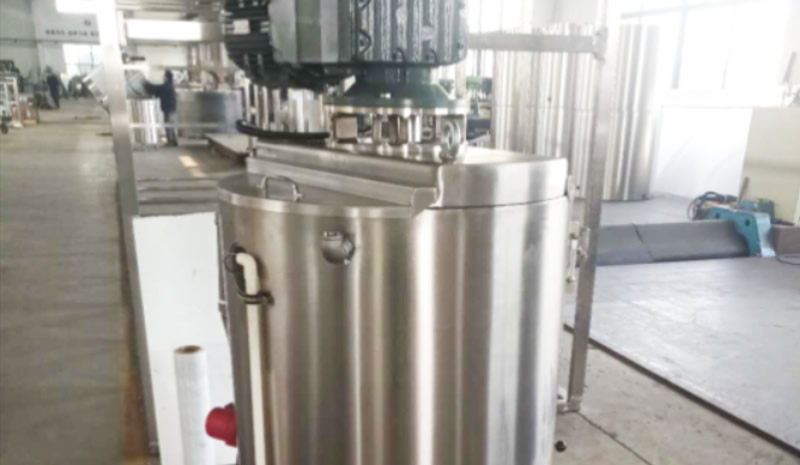

What are the common capacities and power levels of chocolate ball mills, and what are their main functions.
The chocolate ball mill is used to uniformly mix raw materials such as chocolate powder, sugar powder, and cocoa butter, and refine them into a fine chocolate paste. Through the frictional action of grinding stones or balls, chocolate particles are ground to the desired particle size to obtain a smooth chocolate paste. Chocolate processing requires high temperature control. The chocolate ball mill is equipped with a temperature control system that can monitor and control the temperature of the chocolate paste in real time, ensuring that processing is carried out within an appropriate temperature range. Proper temperature control can maintain the quality and fluidity of chocolate. The ball mill can control the fineness and particle size of the chocolate paste by adjusting parameters such as the spacing and rotational speed of grinding stones or balls. This allows for the adjustment of the particle size of the chocolate paste according to the requirements of different products, meeting market demands. The chocolate ball mill fully mixes the chocolate paste through the movement of grinding stones or balls, ensuring the uniformity of raw materials. This helps to improve the quality and consistency of chocolate products in terms of taste.
Modern chocolate ball mills are equipped with advanced automated control systems that can automatically perform processing operations according to preset parameters and programs. This includes automatic control of processing time, temperature, speed, and other parameters to improve production efficiency and consistency.
Safety protection and alarm: Ball mills typically feature safety protection functions, such as emergency stop buttons and overload protection, to ensure the safety of operators and equipment. Additionally, the control system can monitor and trigger alarms to alert operators to any abnormalities.
Common capacities and power of chocolate ball mills.
Small ball mill: Typically featuring a smaller capacity, it is suitable for small-scale or pilot production. The capacity range is usually between 5 liters and 20 liters, and the power range is between 0.75 kilowatts (kW) and 3 kW.
Medium-sized ball mill: suitable for medium-scale chocolate production. The capacity range is typically between 20 liters and 100 liters, and the power range is between 3 kilowatts (kW) and 15 kilowatts (kW).
Large ball mill: suitable for large-scale chocolate production lines. The capacity range is usually above 100 liters, which can reach several hundred liters or more, and the power range is above 15 kilowatts (kW), which can reach several tens of kilowatts (kW) or more.